By Mark Charlinski, President and CCO, LodgIQ

I wrote recently about how loosely our industry defines “AI” itself, and how nearly every session at this year’s Hotel Data Conference used the word without ever pinning down what it meant. That was not the only gap I noticed there.
Almost every session talked about capability. Almost none talked about the people who would actually have to change how they work to benefit from it. Even a precisely defined tool fails if the people asked to use it were never given the time to trust it. I came away less concerned with which AI tools hotels are buying, and more concerned with who inside those hotels is actually going to use them.
That imbalance shows up in the numbers. An industry survey1 found that 42% of hoteliers believe their own employees experience workplace technology as a source of friction rather than help, often because training was rushed and interfaces were left too complex to learn on the job. A tool that a team does not trust gets used halfway, or not at all, regardless of what it is capable of in a demo.
Trust in a new tool builds unevenly
Every commercial team I have worked with has both kinds of people: some who lean toward trying a new tool and pushing it further, and some who lean toward resisting it until it proves itself. Neither instinct is wrong on its own. The initiatives that actually succeed are the ones that put the first group in front of the room early, not the ones with the longest feature list.
Trust in automation gets built in stages, the same way a revenue team might start by letting a system suggest a price while a person still decides, then let it act inside guardrails once the logic has proven itself, before finally stepping back and monitoring it at a strategic level. Skip that sequence and adoption stalls no matter how good the underlying model is.
A short hackathon decides who should lead the rollout
That same staged logic is why the first move should be small: give one team dedicated time, point them at one real problem, and let them work through it with an AI tool while someone is still there to catch it. It is the fastest way to find out who is ready to lead the rollout.
The employees who push past the first answer and actually solve something are the ones ready to champion what comes next. The ones who get frustrated early are not failing so much as telling you where training or interface work still needs to happen before the wider rollout begins.
None of this shortens the actual rollout, and it should not. Once a hackathon has surfaced a champion and proven the pattern works, the deployment that follows, across every property in the portfolio, still takes the time it takes. What changes is who leads it, and how much less resistance the rest of the organization offers once the early adopters have already answered the hardest questions.
Our own numbers show what happens when that sequence gets skipped
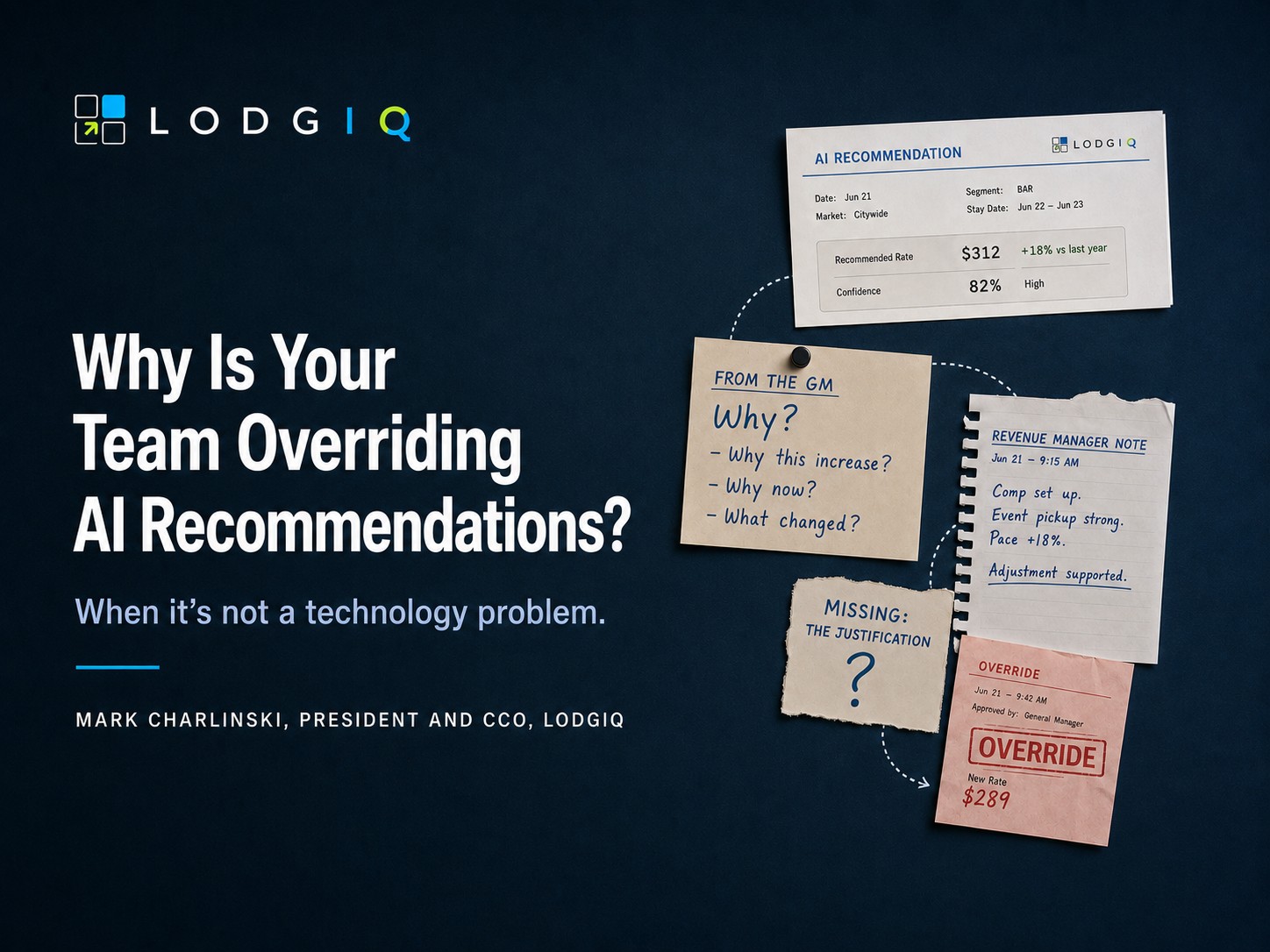
More than half of the pricing recommendations an unexplained system produces get overridden industry-wide, not out of carelessness, but because a recommendation without reasoning is not something a person can defend to their GM or their owner. That override rate is rarely a sign the technology is wrong. More often, it is what happens when a team is handed a fully automated answer with no monitor stage and no guardrail stage in between, nothing to build trust on before being asked to accept the output blind.
That is why we built the reasoning into every recommendation LodgIQ produces, so a team can move through the stages instead of being asked to trust a black box on day one. Fewer overrides is not a satisfaction metric, it is the difference between a recommendation that changes a rate and one that just sits in a queue, and that difference is what turns into profit.
The technology question is largely solved. The harder, more interesting question is whether your organization has given itself the time and structure to actually use it.
If you want to talk through how your team is approaching AI adoption, and where the gaps might be, book time with our team.