By Mark Charlinski, President & CCO, LodgIQ

I sat through most of the sessions at this year’s Hotel Data Conference, and by the second day I noticed something odd. Almost every panel mentioned AI. Almost none of them defined it.
That is not a small omission. “AI” is currently doing the work of three very different things at once: predictive algorithms that forecast demand, generative tools that produce text or images, and autonomous agents that take action on their own. Vendors, speakers, and yes, sometimes I include myself, use the word interchangeably, as if the distinction did not matter. It matters enormously. A system that predicts a rate is a fundamentally different proposition from a system that decides to change it without asking.
The cloud went through this exact hype cycle
I have seen this pattern before. A decade ago, “the cloud” went through the same cycle. A broad, useful idea got flattened into a marketing word, applied to anything with a server behind it, until the term stopped telling anyone anything useful. The misuse, the data integrity questions, and the security shortcuts that followed were not accidents so much as the predictable result of a category being adopted faster than it was understood.
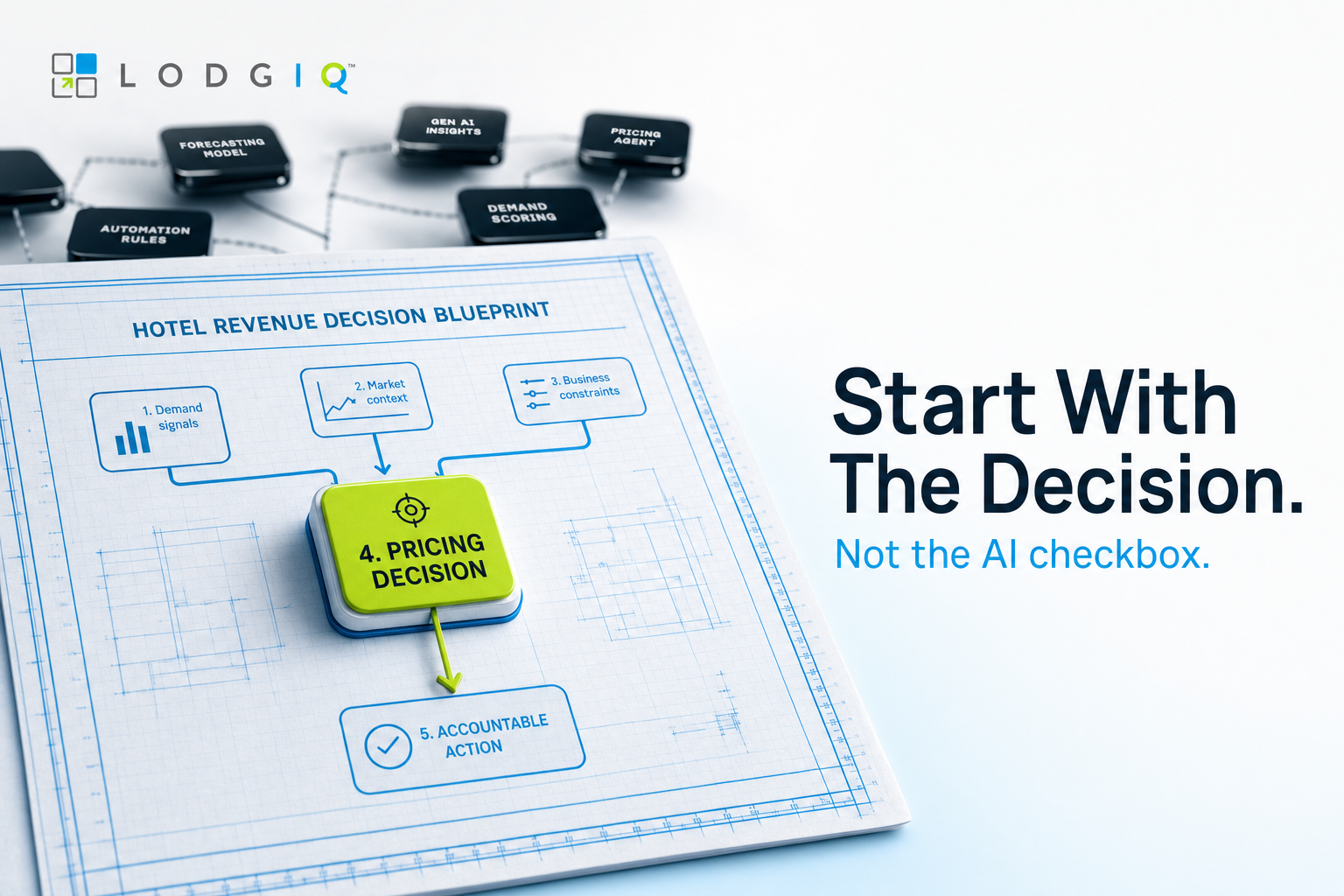
Most conversations today start with the technology: we have AI, what can we do with it? That is backwards. Strategy should start with a real operational problem and treat AI as one possible way to solve it, not as the starting point.
One question from the floor exposed what the sessions kept missing
The clearest proof of this came from the audience, not the stage. Someone raised a genuinely tactical issue: their conference’s first session started at 8 AM, but hotel checkout across the block was 11 AM, so every attendee had to check bags with the concierge before the opening talk. Their proposed fix was narrow and specific: identify the room block tied to conference attendees, extend checkout for that segment, and resequence housekeeping to prioritize the remaining rooms first. It is a small idea. It is also exactly the kind of use case that deserves airtime, because it starts with a real guest-service problem and asks what tool might help, instead of starting with a tool and looking for a problem to justify it. It got almost no discussion. Most of the sessions talked about AI in the abstract.
Defining the problem first
On the panel, I proposed something simple: run an internal AI hackathon. Give employees dedicated time to pick a real problem in their own operation and try to solve it. The value is twofold. Sometimes it actually solves something that has been sitting unaddressed for years. And it tells you, faster than any vendor pitch, who inside your organization has genuine capability with these tools and who is simply repeating the word. Start small, learn from it, then expand.
I bring this up because our own approach at LodgIQ only holds together if we are not guilty of the same confusion. When we built the platform, we started with what was actually costing commercial teams their time, not with what our AI could do: hours spent assembling data across disconnected systems every morning, and recommendations that arrived without any explanation, which is exactly why so many of them get overridden. Predictive, generative, and agentic AI came later, as layers applied to that specific problem, sitting behind a conversational interface so a person is always the one asking the questions and directing the work, not just receiving output from something they cannot challenge. That order is what made the time we gave back actually matter, and what let trust build instead of erode. Whether that turns into more revenue or better margin depends entirely on whether the recommendations produced that way get used, at scale, and that is the only place profitability ever comes from.
AI is a tool, not a strategy, and no amount of sophistication under the hood replaces the discipline of defining the problem first. Its value depends entirely on the precision of the hands that pick it up.
If you want to talk through where AI genuinely fits in your commercial operation, and where it does not, book time with our team.