By Mark Charlinski, President and CCO, LodgIQ

A few weeks ago I sat down with an investor who has spent the better part of a decade backing hotel technology companies, watching pitches come and go from the other side of the table. I asked him something simple. When a vendor tells you they have AI, how do you actually know if that is true.
His answer was direct. The vendors who will win are not the ones who added an AI feature, but the ones who rebuilt the company around it, product and operations both. Everyone else is mostly wrapping someone else’s model in a familiar interface and hoping the buyer does not ask too many questions.
The word AI has stopped telling buyers anything
Every vendor in this market has learned to say the word. Revenue management, CRM, distribution, guest messaging. AI shows up on every slide. That uniformity is exactly the problem. A word that describes everything stops describing anything, and a buyer comparing three proposals that all claim the same capability has no way to tell which claim is real without asking a different kind of question.
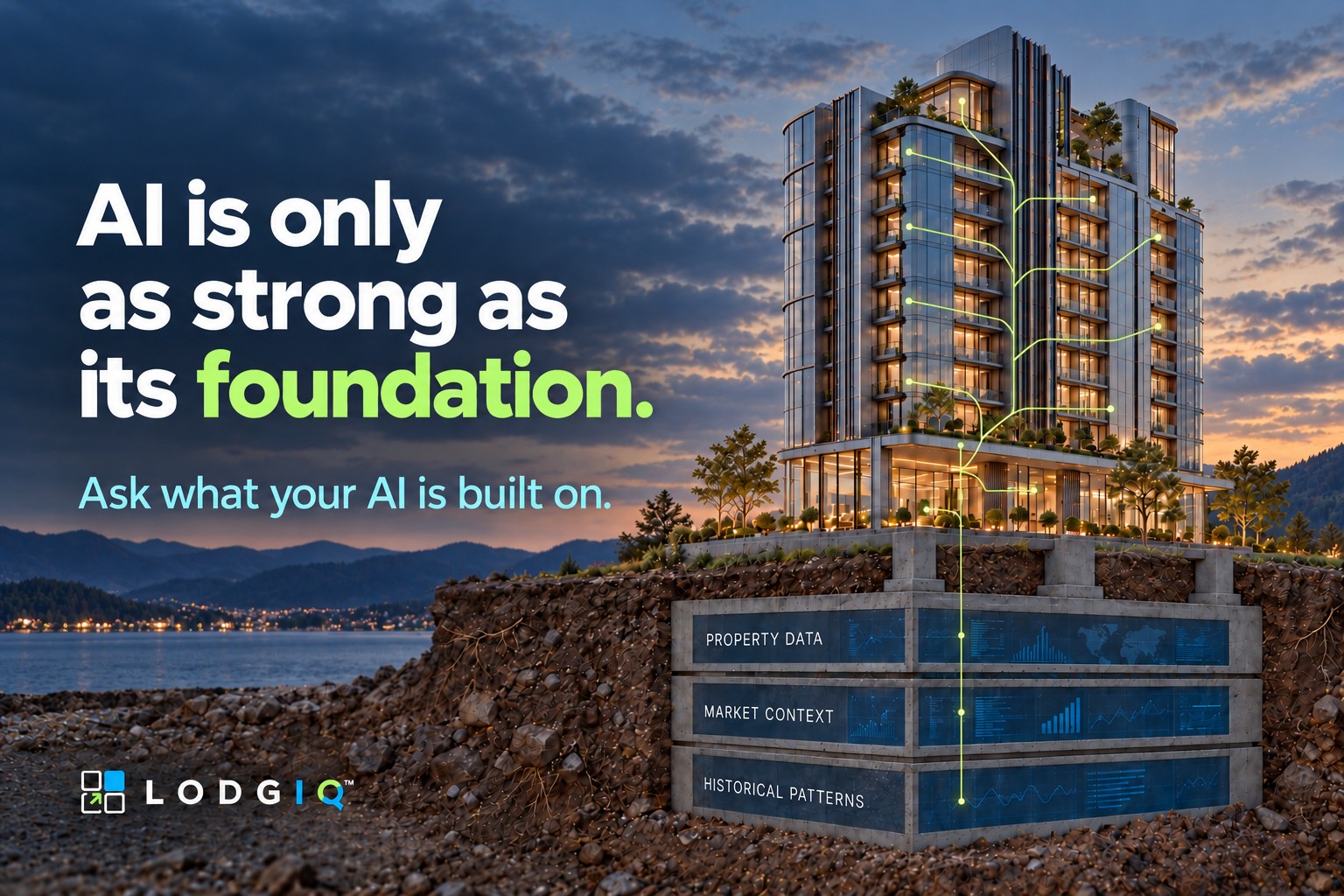
The distinction the investor draws is not about how new the technology is. It is about whether a company has spent years building the integrations, the data pipelines, and the institutional memory that together let a model reason about a specific property instead of hotels in general. A company with that foundation can tell you what changed in your market yesterday and why it matters to your rate tomorrow. A company without it can generate a fluent, confident answer to almost any question, and that answer will sound just as good whether or not it has anything to do with your portfolio.
That is what makes this hard to catch in a sales conversation. Vendors adding AI features can still demo well. But right now, there is a structural gap between platforms built on that same foundation and those still wrapping someone else’s model in a familiar interface. The difference shows up the moment you push past the first answer and ask where it came from, whether it is using your actual occupancy, your actual comp set, your actual booking pace, or producing something plausible that happens to fit the shape of the question.
For a single property, overlooking that gap might feel manageable. A general manager can sanity check a recommendation against what they already know about their own hotel. Across a portfolio, the same gap multiplies. An owner or asset manager reviewing ten or twenty properties cannot personally verify whether each recommendation reflects that property’s actual market, or a generic pattern the model has seen work elsewhere. At scale, the difference between grounded and generic stops being a nuance and becomes the whole question.
A few questions in the room reveal the difference
I would suggest asking a vendor three things before signing anything. What does your system know about my portfolio today that it did not know yesterday. Can you show me the reasoning behind a specific recommendation, not just the recommendation itself. And if I disagree with what it is telling me, can I ask why, and will the answer be grounded in my own data. A vendor with real infrastructure behind their AI claim will answer all three without hesitation. A vendor without it will pivot to talking about the model they are using instead of what it actually does for you.
The cost of getting this wrong shows up later, not in the demo
Getting this wrong is expensive in ways that do not show up until later. A recommendation you cannot interrogate is one you will either follow blindly or override out of habit, and neither choice protects your margin. Every recommendation is expected to explain itself, in plain language, so a revenue leader can trust it enough to act on it quickly, or challenge it and get a real answer, rather than guessing at what a black box decided on its own. That kind of visibility is not a convenience. It is what turns a recommendation into a decision you can defend to your owner, and it is what preserves profitability when the market moves faster than your team can track it manually.
Demand keeps moving while a recommendation waits for a decision. The practical value of AI lies in helping teams act while there is still time to capture an opportunity or address a risk.
–
Discover LodgIQ
Every day spent building reports is another day revenue decisions wait.
While your team pulls data together and prepares the next report, demand shifts and revenue opportunities can slip by. Putting off a better way of working means carrying that same cost into tomorrow.
LodgIQ’s AI-powered Revenue Operations Platform is built as the next step beyond a traditional RMS. It assembles the data, analyzes performance and surfaces recommended actions before the workday begins, then keeps monitoring throughout the day. Your team sees what needs attention, why it matters and the expected revenue impact, with explanations they can question and act on.
Already using an RMS? LodgIQ can work alongside it.
Book 15 minutes to see how LodgIQ can help your team act sooner on revenue opportunities