By Samuel Johnson, Head of Operations, LodgIQ

For many independent hotels, revenue management happens in the gaps. Between the morning briefing and the first check-in, on a quiet afternoon, or at the end of a long day when someone finally has time to look at next month’s numbers. The person making those pricing decisions is often also managing the front desk, handling supplier relationships, and overseeing the guest experience.
In that context, a revenue strategy typically means checking what nearby competitors are charging, adjusting rates when occupancy looks thin, and leaning on last year’s booking data to anticipate what’s ahead. That approach is built on genuine experience and local knowledge. It also leaves a significant amount of revenue on the table.
(Read more: 5 Signs It’s Time to Stop Relying on Spreadsheets (Or Replace Your Current RMS) )
The independent hotel paradox
There is a common assumption that revenue management systems are built for large chains with dedicated commercial teams. Independent hotels and small groups arguably need RMS technology more than large chains, precisely because their margin for error is smaller. A pricing mistake cannot be absorbed across hundreds of transactions. One underpriced weekend, one missed compression event, one rate that failed to adjust before a block of rooms sold at the wrong price. Each has a measurable impact on a property running lean.
For independent hotels, access has always been the real obstacle.
The access barrier has changed
For years, enterprise RMS platforms were priced and designed for chains, with investment levels that put them out of reach for most independent properties. That dynamic has shifted. What was once an enterprise investment of $30,000 to $50,000 is now accessible at a fraction of that cost, with setup fees typically between $7,000 and $10,000 and ongoing fees structured around room count rather than flat enterprise pricing. The technology has been redesigned for smaller teams, with interfaces built around ease of use. A GM or front office manager with no formal revenue management background can operate these systems effectively from day one.
What actually changes
For a property where one person manages pricing alongside everything else, the time recovered by automating rate management is not abstract. Industry data puts that recovery at 20 to 40 hours per month, the difference between a week spent on commercial decisions and a week spent on data entry.
Beyond time, the change is one of visibility. A small team managing rates manually is always working from a partial picture: what competitors charged yesterday, what last year looked like at this point in the season. An RMS replaces that partial picture with live demand signals, adjusting rates automatically within parameters the team defines, across every channel and without requiring manual oversight. When a local event creates unexpected demand three weeks out, the system responds. When booking pace accelerates or slows, the system adjusts. For a property with limited buffer against pricing errors, that accuracy compounds with each booking cycle.
A transition designed for small teams
The concern most often heard from independent hoteliers is disruption. Adding a new system to an operation already running at full capacity feels like a risk.
The evidence from hoteliers who have made the transition points in a different direction. The most effective approach is phased: beginning in monitoring mode, where the system suggests and the team decides; moving to semi-automatic operation within defined parameters; and reaching full automation once trust has been established. The process typically runs over 8 to 12 weeks, after which the system operates quietly in the background while the team redirects its energy toward work that requires human judgment.
Revenue management built on instinct and experience will always have a place. The most effective commercial strategies combine that judgment with accurate, real-time data, giving small teams the same decision-making foundation that larger properties have long relied on.
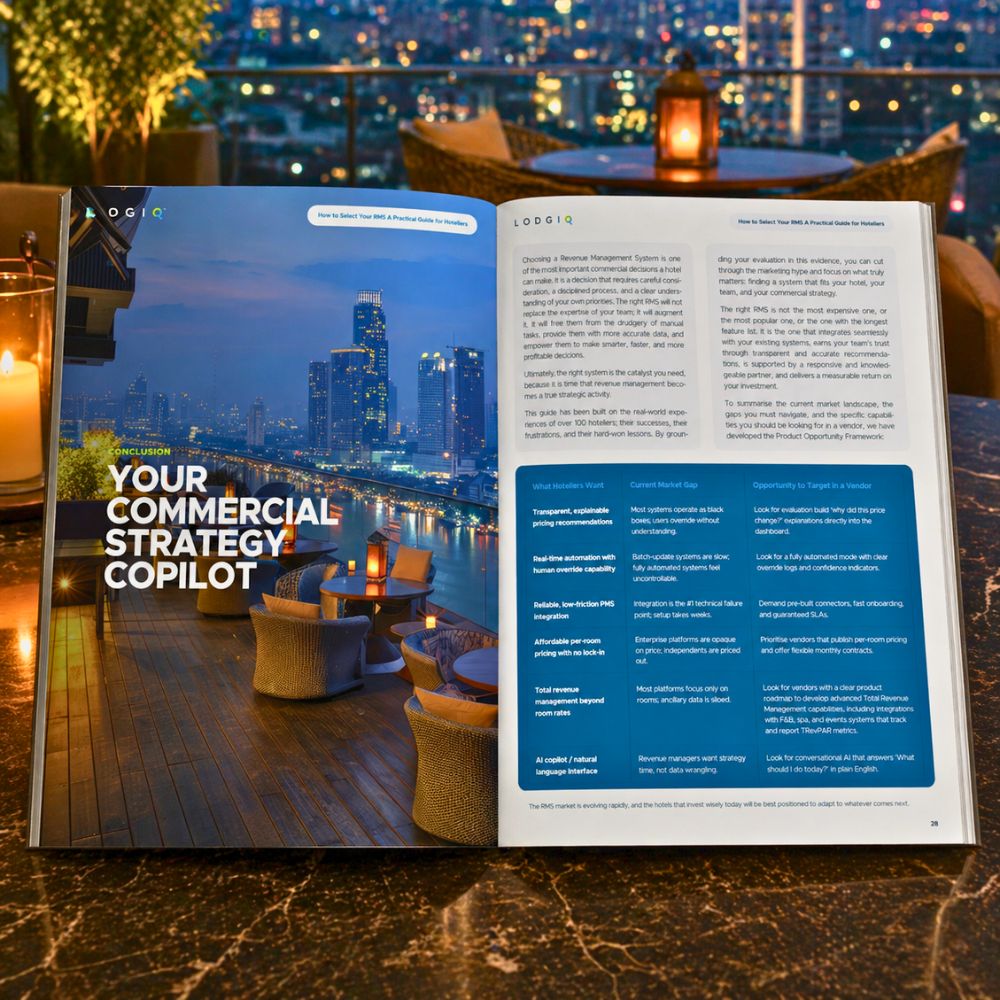
How to Select Your RMS: A Practical Guide for Hoteliers includes a dedicated section on independent and boutique hotel profiles, with guidance on which capabilities to prioritize based on your property’s size, team structure, and market.
Download The Full Guide: How to Select Your RMS: A Practical Guide for Hoteliers