By Samuel Johnson, Head of Operations, LodgIQ

The decision usually does not arrive as a formal strategic review. It arrives on an afternoon when a key weekend is filling up, a competitor’s rate has just moved, and the spreadsheet open in front of you was last updated two days ago. By the time you have built a clear picture of the situation, the market has already shifted.
The case for moving beyond manual processes is rarely the hard part. Most hoteliers who are running on spreadsheets already know that something needs to change. The harder question is knowing when the situation has become critical enough to act, and how to make the right choice without making a costly mistake.
The five signs below are designed to help with the first part of that question. The second part is answered at the end of this article.
1. Your booking windows have become completely unpredictable
There was a time when a three-to-six-month booking window gave revenue managers a comfortable runway for planning. Today, we see a significant share of reservations arriving within 30 days of check-in, and sometimes within 7 to 14. When booking patterns compress this sharply, a system built on historical data alone is always looking backward while the market moves forward. Reading real-time demand signals, rather than extrapolating from patterns that may no longer apply, becomes operationally essential.
2. You spend more time on data entry than on commercial strategy
Manually tracking competitors, adjusting rates across channels, and compiling reports creates what many revenue managers describe as a “time gap.” The hours spent compiling and cross-checking are hours that cannot be redirected toward strategy. Research shows that moving from manual processes to an automated RMS saves hotel teams an estimated 20 to 40 hours per month. That time becomes available for channel performance analysis, marketing alignment, and the commercial decisions that shape a hotel’s results.
3. Your pricing follows the market instead of anticipating it
A pricing approach built on observing what your competitive set is doing and adjusting afterward keeps you permanently behind the curve. Demand signals move faster than manual processes can capture. Hotels that act on those signals ahead of the market consistently outperform those that respond to them. When effectively implemented, RMS platforms are associated with average RevPAR improvements of 15 to 20%. Most of that performance gap comes down to timing.
4. You are relying on spreadsheets to run a complex asset
Excel is a capable tool, designed for analysis and calculation. Optimizing real-time, multi-variable pricing across a modern hotel’s distribution landscape requires a different class of system entirely. The risk is well-documented: research shows that over 80% of spreadsheets used in hotel operations contain errors. Those errors accumulate quietly. A wrong rate pushed to a channel, a restriction missed during a high-demand period, a booking opportunity that leaves no trace. If your revenue strategy depends on a spreadsheet, the exposure is structural and compounds over time.
5. You have an RMS, but you do not trust it
This sign is perhaps the most consequential, and the most underestimated. Around 10% of hotels have invested in advanced RMS technology. But when a system generates rate recommendations without explaining the reasoning behind them, experienced revenue managers respond as any professional would: they override it manually. The result is a system running in parallel with the judgment it was supposed to support, with neither producing its best outcome.
This “black box” problem is increasingly recognized as a fundamental obstacle to adoption. The most effective modern platforms are designed around a different model, where the system functions as a transparent AI copilot, capable of explaining the market factors, pacing signals, and competitive context behind each recommendation. When a revenue manager can see the reasoning, trust follows, and automation can finally deliver on its promise.
This dynamic also captures something broader about where the revenue management role is heading. A revenue manager who spends their day defending decisions based on opaque system outputs is operating well below the level the role is designed for. A revenue manager supported by a system they understand can act as a genuine commercial strategist.
From diagnosis to decision
If any of these five situations describes your property, the case for acting is clear. What comes next requires more care.
The RMS market has changed significantly in recent years. Cloud-based architectures have brought setup costs down from historically prohibitive levels, $30,000 to $50,000 in the enterprise era, to a range of $7,000 to $10,000 today, with ongoing fees typically running $6 to $10 per room per month. More vendors are now competing for the independent and mid-size hotel segment. That broader choice is good news for buyers. It also means the evaluation process requires more discipline.
A poor choice carries real costs: integration failures that disrupt operations, onboarding processes that stall adoption, and contract structures that are difficult to exit. The consistent finding from real-world implementations is that a poorly chosen RMS creates more friction than no RMS at all.
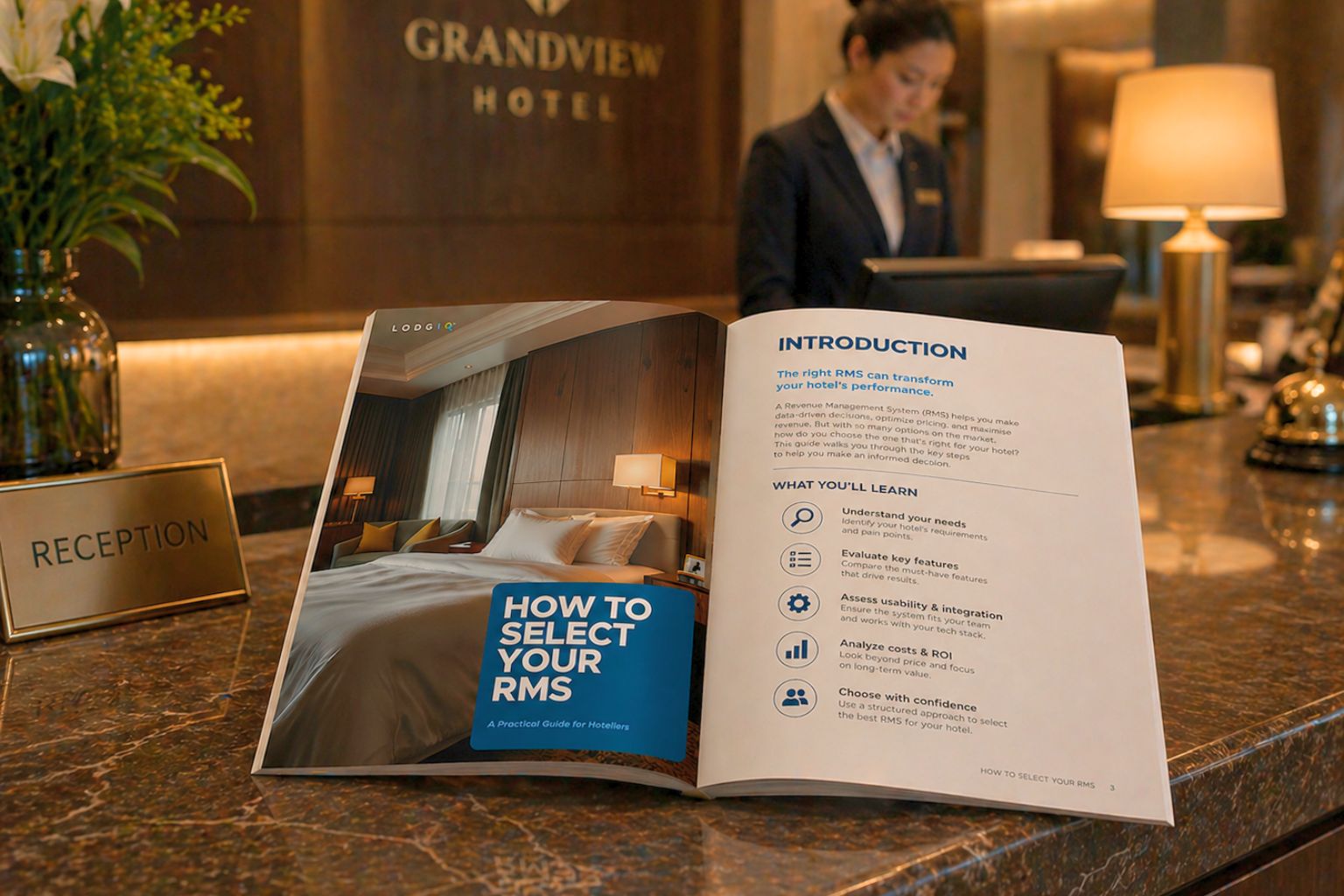
To help hoteliers navigate this decision, we compiled How to Select Your RMS: A Practical Guide for Hoteliers, built on the real-world experiences of over 100 hoteliers and grounded in leading industry research.
The guide was built for Revenue Managers, General Managers, or Directors of Commercial Strategy who need a structured, evidence-based framework before signing a contract. It is designed to give you the tools to evaluate vendors on your own terms.
Now Available For Download: How to Select Your RMS: A Practical Guide for Hoteliers