
The most asked question about what happens in hotels is: Why do hotel rates change so dramatically, sometimes doubling overnight?
We’re the reason that happens, but here’s why and how it works.
You check a hotel on Monday and the room is $180. You come back on Tuesday, and suddenly it is $340. Same room, same bed, same breakfast, same view of the city, and yet the price has changed so dramatically that it feels almost absurd. Most travelers immediately assume the hotel is simply taking advantage of demand, or worse, making prices up as they go. It feels arbitrary, mysterious, and sometimes even unfair.
At LodgIQ, we build the systems that help hotels make those pricing decisions, so yes, in many cases, we are the reason those prices change. We are the people behind the curtain, helping hotels decide when rates should rise, when they should fall, and how to avoid getting it wrong. But contrary to popular belief, the goal is not to make prices as high as possible. In fact, pricing too high can be just as damaging as pricing too low. The real objective is to find the right price, the one that matches demand, protects profitability, and still makes sense for the guest.
The reason hotel pricing behaves so differently from other industries is because hotel rooms are one of the strangest products in business. A hotel cannot simply create more inventory when demand increases. A retailer can order more stock. A restaurant can add another table outside. A hotel with 300 rooms tonight has exactly 300 rooms, and not one more. If one of those rooms remains unsold by midnight, that revenue is gone forever. It cannot be stored, discounted next week, or sold tomorrow. In many ways, a hotel room behaves more like fresh flowers than like a physical product. If it is not sold today, it expires (though flowers can still be discounted the next day).
This creates enormous pressure around pricing. If a hotel prices too low, it may fill up quickly, but it also leaves significant revenue behind. Selling out sounds like success, but if every room sold far below what guests were actually willing to pay, the hotel has simply worked harder for less return. That also means more operational pressure, more housekeeping, more wear and tear on the property, and less profit to reinvest into service, maintenance, and staff. On the other hand, if prices are too high, guests book elsewhere, rooms remain empty, and the hotel loses revenue it can never recover. The challenge is not to maximize price, but to optimize it.
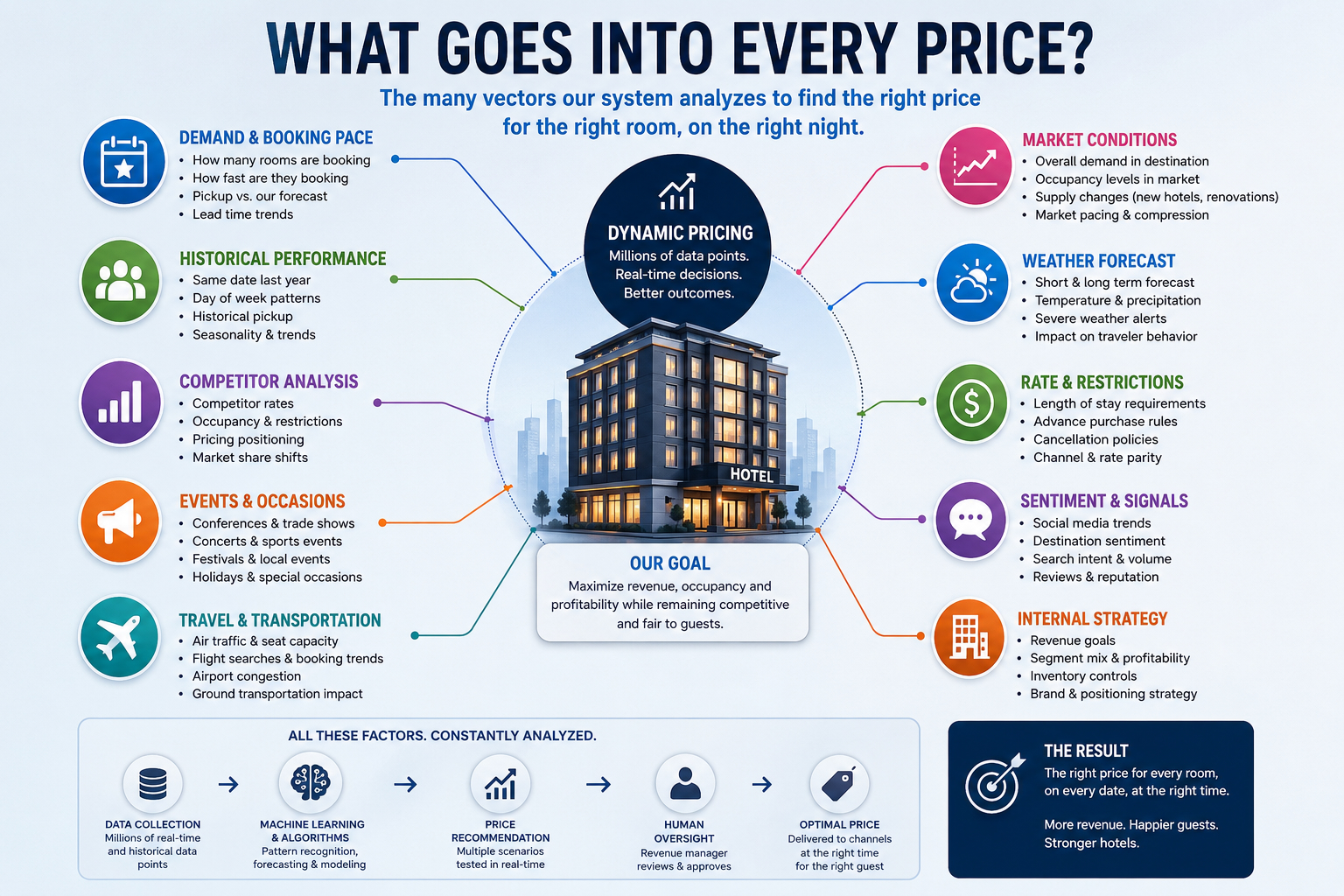
That is where revenue management comes in. Our systems are designed to help hotels understand demand before it fully arrives. We look at how quickly rooms are booking, how many searches are happening, how competitors are pricing similar rooms, and how the market behaved during the same dates in previous years. We also monitor major events such as conferences, concerts, sporting events, trade shows, and holidays. A large congress in London, for example, can suddenly create thousands of additional room requests for just a few nights. A concert by Taylor Swift can reshape pricing across an entire city within hours.
What often surprises people is how quickly these changes happen. Sometimes the event itself is not even the trigger. The trigger is the speed of bookings. A few people book early at normal prices, and then the system notices something unusual: rooms are disappearing much faster than expected. It compares that booking pace to historical patterns, competitor performance, airline arrivals, and market availability. If it detects that demand is accelerating and inventory is tightening, it recommends a higher rate. That is why a room can appear to double overnight. The room itself did not change. The market around it did.
People or Machines?
People often ask whether a machine or a human is actually setting the price. The answer is usually both. Modern revenue management systems make recommendations based on millions of data points, but there is still a human revenue manager reviewing those decisions. Sometimes the human slows things down because they know something the system cannot see yet. Sometimes they push prices higher because they believe demand will be stronger than the data suggests. And sometimes they get it wrong.
This happens often around major global events like the Olympic Games. Hotels become convinced that demand will be extraordinary and manually increase rates far beyond what the system recommends. Owners see headlines, hear predictions, and decide they should double prices because surely everyone will be coming. But the machine is looking only at actual booking behavior, not emotion. In many cases, the demand never fully arrives, and those same hotels are forced to reduce rates later because they overestimated the market. Revenue management is not about greed. It is about discipline.
Competitor pricing also plays a bigger role than most guests realize. Hotels watch each other constantly. If a nearby luxury hotel raises its prices, others may feel pressure to follow. Sometimes that decision is logical. Sometimes it is driven by pure fear of missing out. Owners will say they never want to be cheaper than the hotel across the street because they believe their product is better. But that competing hotel may be full for reasons nobody can see, such as a private group booking, a corporate contract, or even a sudden burst of visibility from a viral social media post. Following competitors blindly can leave a hotel overpriced and empty.
Can you trick the system?
Guests also love asking whether there is a secret trick to beating the system. The truth is there is no universal best day to book. Rates are not updated every Friday by someone with a spreadsheet. They are adjusted continuously based on live demand. If there is any real way to “game” hotel pricing, it usually comes down to timing.
The first strategy is being unusually early. If you know something before the rest of the market knows it, you can often book before prices react. If you somehow know a major artist is announcing a concert, or a major convention is coming to town before it becomes public, booking immediately can lock in a much lower rate. Once that information reaches everyone else, demand floods in and prices rise fast. In many ways, it works like insider information in the stock market (except it isn’t illegal).
The second strategy is being very late. On the night itself, some hotels may decide that selling a room at half price at 10:30 p.m. is better than leaving it empty. Same-day bookings can sometimes reveal surprisingly low prices. But this is risky, because if demand remains strong, prices may continue rising instead. Last-minute deals usually happen when a hotel misjudged demand and needs to fill unsold rooms quickly. When revenue management is working perfectly, those dramatic last-minute discounts often do not happen at all.
Hotel pricing can feel frustrating from the outside because it does not behave like traditional shopping. It behaves more like airline tickets or even financial markets. It is dynamic, constantly reacting to supply, demand, and confidence. The goal is not to charge the highest possible price. The goal is to charge the right price for the right room at the right time.
That is what we do. We are the reason prices move, but we are also the reason they make sense. A well-priced hotel protects the business, supports the guest experience, and avoids the chaos of overpricing or panic discounting. Behind every dramatic overnight rate change is not a random decision, but a constant effort to balance fairness, profitability, and the reality that every empty room disappears forever at midnight.
We hope this helps clarify the strange effects of changing hotel prices.