By Sam Johnson, Head of Operations, LodgIQ

Reporting is often treated as proof of control: more views, more packs, more status updates. For a hotel owner or operator, the sharper question is not whether the numbers exist. It is how long it takes before a commercial decision exists and is executed.
When revenue teams spend a large share of their week building manual reports, moving between disconnected systems, or preparing different updates for different stakeholders, the cost is not only administrative.
It is time immobilized inside the operating cycle.
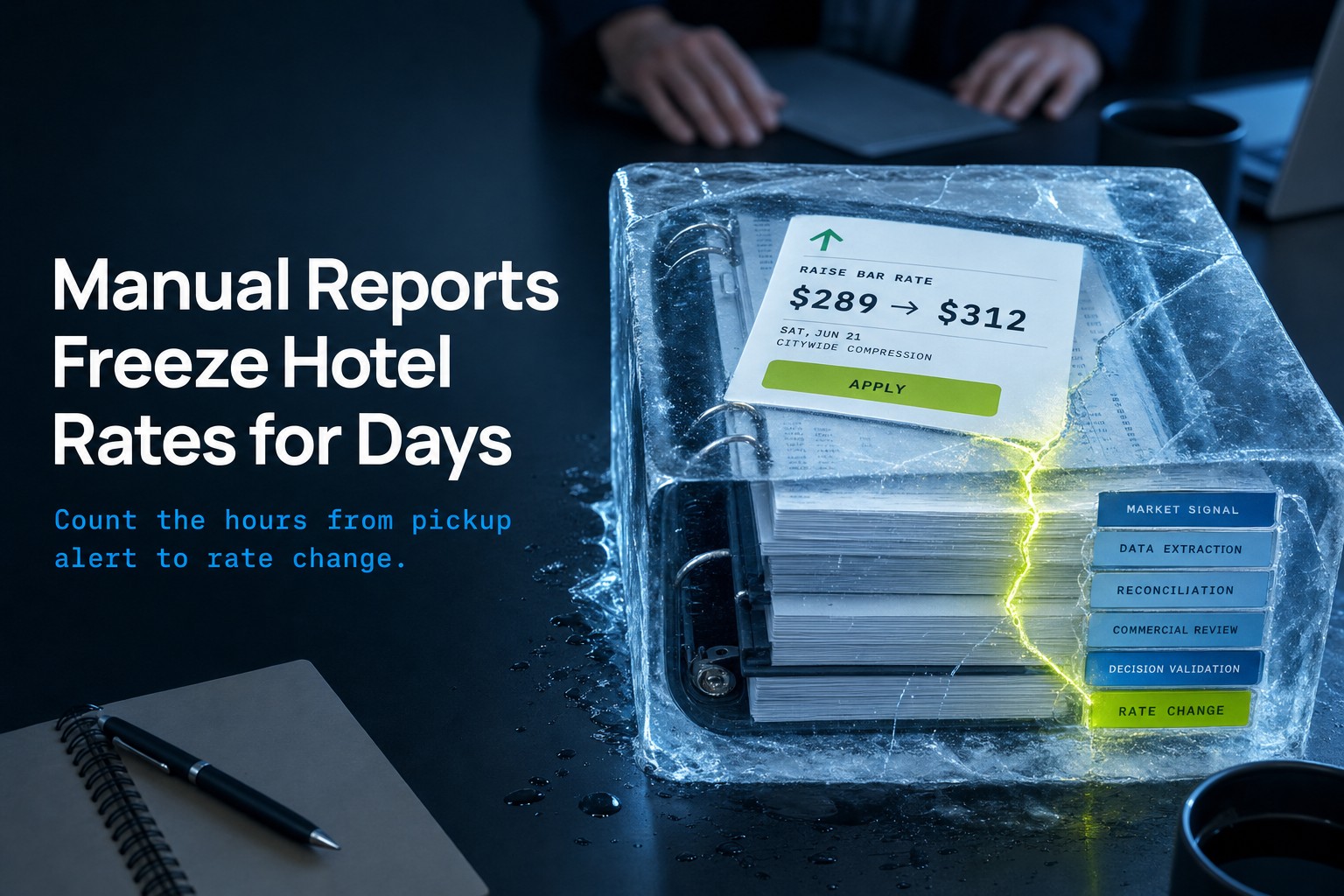
A market signal appears. The team detects it, extracts the relevant data, reconciles sources, prepares commentary, arbitrates across revenue, sales, marketing, or property leadership, validates the decision, then finally changes rate, availability, channel focus, or mix.
Delay can accumulate at every step:
- detection, when too many alerts, charts, and tabs make it unclear which signal matters;
- extraction, when teams need to pull information from disconnected tools;
- reconciliation, when numbers must be double-checked before anyone acts;
- commentary, when each department prepares its own explanation;
- arbitration, when revenue, sales, marketing, and leadership do not share the same context;
- validation, when the decision waits for another round of status updates;
- action, when the pricing or mix change happens after the opportunity has already moved.
That makes reporting time an economic signal. Stronger revenue workflows change the balance: less time assembling and reconciling the picture, more time turning it into commercial action.This matters most for owners, asset managers, executives, and general managers because their accountability is not report completion. It is portfolio performance and bottom-line outcomes.
The real failure is decision lag
The usual objection is that reporting is already handled: dashboards exist, alerts arrive, weekly packs circulate. But visibility is not the same as decision speed.
A revenue team can be surrounded by charts and still hesitate because the workflow does not answer the operational question: “Has a decision been made, and has it been executed?”
This is where reporting becomes a validation loop. Under pressure to update owners and general managers, teams may delay action not because information is missing, but because outdated tools force them to double-check numbers before moving.
The practical test is no longer whether a decision can be explained after the fact. It is whether the workflow reduces the measurable delay between signal, decision, and action.
The hidden cost lies in time lost before the story becomes a decision and the decision becomes action.
A decision audit should start with hours
The next step is not a better chart. It is a better audit of where time goes.
Ask each property four questions:
How many hours are spent producing revenue reporting?
How many hours are spent reconciling numbers across systems?
How many hours are spent writing commentary for different stakeholders?
How many commercial decisions actually come out of that work?
If reporting consumes the week but produces few pricing, availability, channel, sales, or mix decisions, the issue is not a lack of effort. It is that strategic revenue work is being squeezed out by manual production, disconnected systems, and constant status updates.Decision support becomes useful when it reduces the interpretation work between a signal and an action. That means showing context, reading the signal, and surfacing likely root causes: why performance changed, why pickup moved, why forecasts shifted, why rates should change, and what to do next.
When the workflow gives teams a common interpretation of performance, meetings can move from “which number is right?” to “which decision follows?”
Measure the workflow with three timestamps
Once the workflow is measured by decision speed, technology evaluation becomes less abstract.
The question is no longer “which system has more features?” but “which operating conditions reduce the delay before action?”
Use three timestamps:
Signal timestamp: when did the market or performance signal first appear?
Decision timestamp: when did the team decide what to do?
Action timestamp: when was the rate, availability, channel, sales, or mix action executed?
The gap between those timestamps is the decision lag.
Start with the daily-use test. If answering “What should I do today?” requires 12 open tabs, the workflow is not supporting action. It is pushing synthesis back onto the team. That symptom should be treated as an operational defect, not a training issue.
Qualification criteria should be tied directly to decision speed. PMS integration matters because weak integration can keep teams extracting, checking, and reconciling instead of acting.
Other fit questions should be treated the same way: do they reduce the time from signal to action, or do they add another manual workaround?
Portfolio revenue operations should reduce delay
Internal discipline still matters. But discipline cannot compensate for technology that adds noise, fragments work, or turns senior revenue people into the permanent workaround.
At portfolio level, revenue operations should not mean simply centralizing dashboards. A useful platform should reduce the delay between a market signal, multi-functional arbitration, and revenue action.
This is also the right standard for AI in revenue management. AI is not valuable because it is AI.
It is valuable when it reduces complexity, removes manual synthesis, connects signals to revenue outcomes, and helps operators move faster from interpretation to action.
Adoption follows the same logic. Revenue leaders resist systems that appear to replace their judgment. They advocate for systems that elevate it.
The test is therefore simple: does the platform make experts less necessary, or make their expertise travel further across the portfolio before the opportunity has passed?
To analyze the key factors discussed in this article and make informed decisions on the right RMS for your hotel, group, or operations, we have published a downloadable resource: How to Select Your RMS: A Practical Guide for Hoteliers