By Hrishikesh Bapat, Head of Product, LodgIQ

Most RMS evaluations start the same way. You decide you are ready to move beyond spreadsheets, contact two or three vendors, and sit through a series of polished demos. The dashboards look clean, the sales team is knowledgeable, and the integration story sounds seamless. By the end of the process, you sign with the vendor whose presentation felt most convincing.
This is how many costly decisions get made.
A demo is designed to highlight a vendor’s strengths and usually runs on pre-loaded data that looks far cleaner than the reality of a live hotel environment. When the evaluation is vendor-driven, the conversations feel structured and productive, but the questions that actually matter might never get asked.
The six dimensions below are designed to reframe the evaluation. Each one reflects a real-world failure mode, drawn from the actual experiences of hoteliers. Together, they provide a framework for asking the right questions and recognising the answers that matter.
1. Integration
Of the six dimensions, integration is consistently identified as the single most common point of failure in real-world RMS implementations. A vendor who claims compatibility with your PMS is not the same as a vendor with a certified, production-grade, two-way integration running live at multiple properties on your exact system.
The distinction matters because integration is a spectrum. At one end sits a basic, one-way data feed that sends limited information from the PMS to the RMS on a delayed schedule. At the other is a deep, real-time, two-way synchronisation that keeps rates, availability, and restrictions perfectly aligned across all systems at all times. In practice, poor integration means your RMS is working from stale data. Rates and availability sent to the system may already be outdated by the time a pricing decision is made. The system cannot function as a reliable source of truth when the underlying data feed is slow, incomplete, or one-directional. The result is double bookings, hours of manual reconciliation, and a commercial operation built on a foundation it cannot trust.
2. Automation and pricing logic
The capability that earns long-term trust in a pricing engine is transparency, and the gap between a sophisticated algorithm and a trustworthy one matters enormously in practice. When a revenue manager cannot see the reasoning behind a suggested rate, they override it. A system that gets overridden consistently delivers a fraction of its potential value. The most effective modern platforms explain the market factors, pacing signals, and competitive data behind each recommendation, giving the team a foundation for confidence rather than a source of anxiety.
3. Ease of use
A system that is technically capable but operationally cumbersome will not get used. Research shows that 42% of hotel employees consider technology a source of friction, largely due to poor training and complex interfaces. The question that matters reaches beyond how the system looks in a demo. It is whether a GM or front office manager with limited revenue management experience could use it effectively on an ordinary morning. That is the real test of usability.
4. Support and onboarding
The quality of a vendor’s support is rarely visible during the sales process, and it is the dimension hoteliers most consistently regret not evaluating more carefully. There is a meaningful difference between technical support, which covers bugs and integration issues, and strategic support, which helps the team optimise their use of the system over time. Many vendors provide the former. Fewer provide the latter. Asking for specific SLA commitments and references focused on post-go-live support quality will tell you more about a vendor than any demo.
5. Forecasting and reporting
No forecast is perfect, particularly in a market defined by compressed booking windows and unpredictable demand. The key differentiator is how quickly the system adapts when reality diverges from its model. A system that learns and self-corrects based on live booking data is substantially more valuable than one that extrapolates from historical patterns that may no longer apply.
6. Total cost of ownership
Setup costs for modern cloud-based RMS platforms have dropped considerably, from the $30,000 to $50,000 range of the enterprise era to a current range of $7,000 to $10,000, with ongoing fees typically running $6 to $10 per room per month. Those headline figures rarely capture the full picture. Training fees, integration costs charged by PMS providers, tiered support structures, and early termination penalties can significantly alter the total investment. The only reliable basis for comparison is an all-in first-year cost, requested in writing before any contract is signed.
Evaluating on your own terms
These six dimensions share a common logic: each one reflects a real pattern of failure, drawn from how hoteliers have described what went wrong. Using them as the structure for your evaluation keeps the conversation grounded in your priorities from the start.
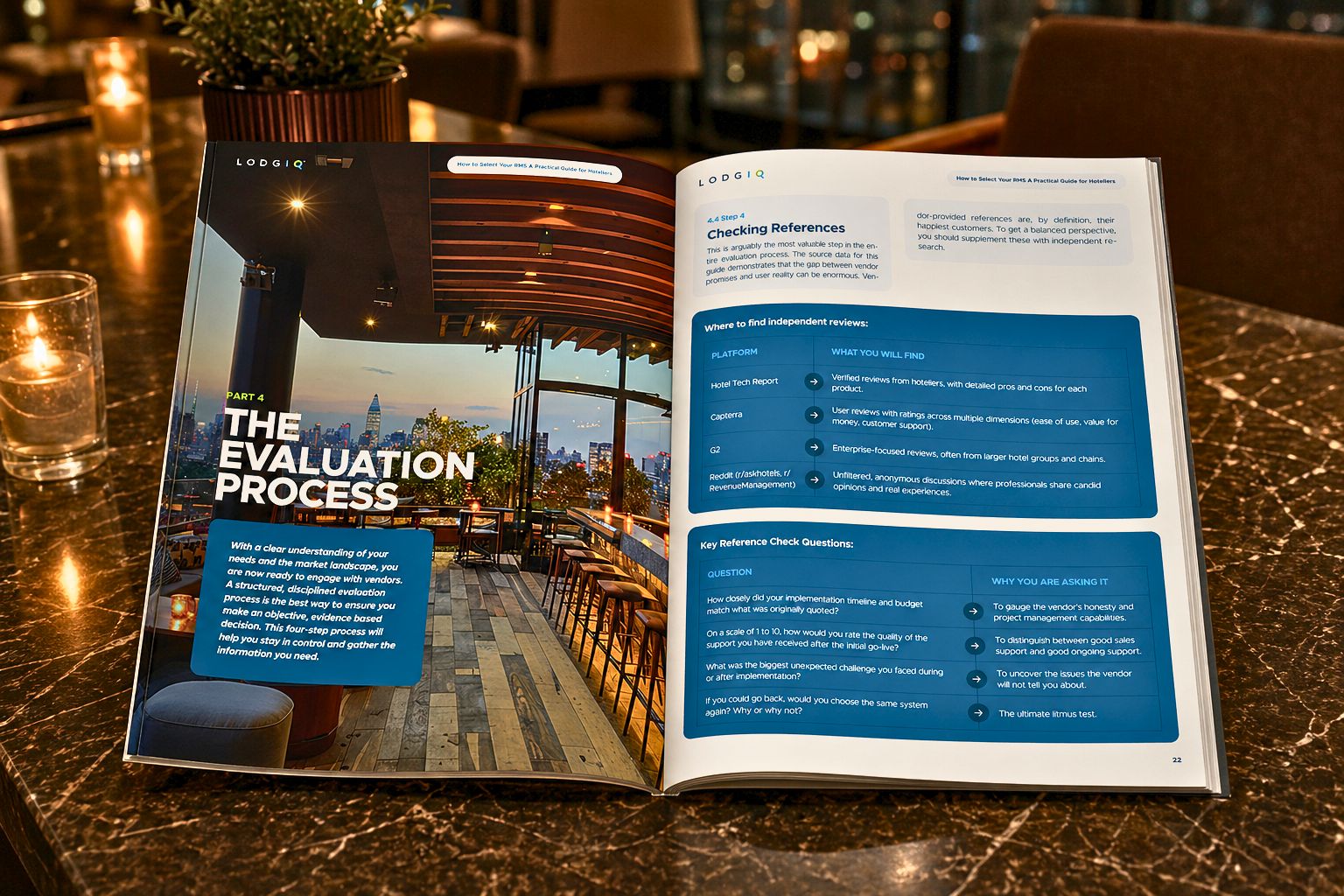
How to Select Your RMS: A Practical Guide for Hoteliers develops each of these dimensions in full, with the specific questions to ask every vendor, the red flags to watch for during the sales process, and a structured framework for comparing responses across your shortlist.
Download The Full Guide: How to Select Your RMS: A Practical Guide for Hoteliers